Table of Contents
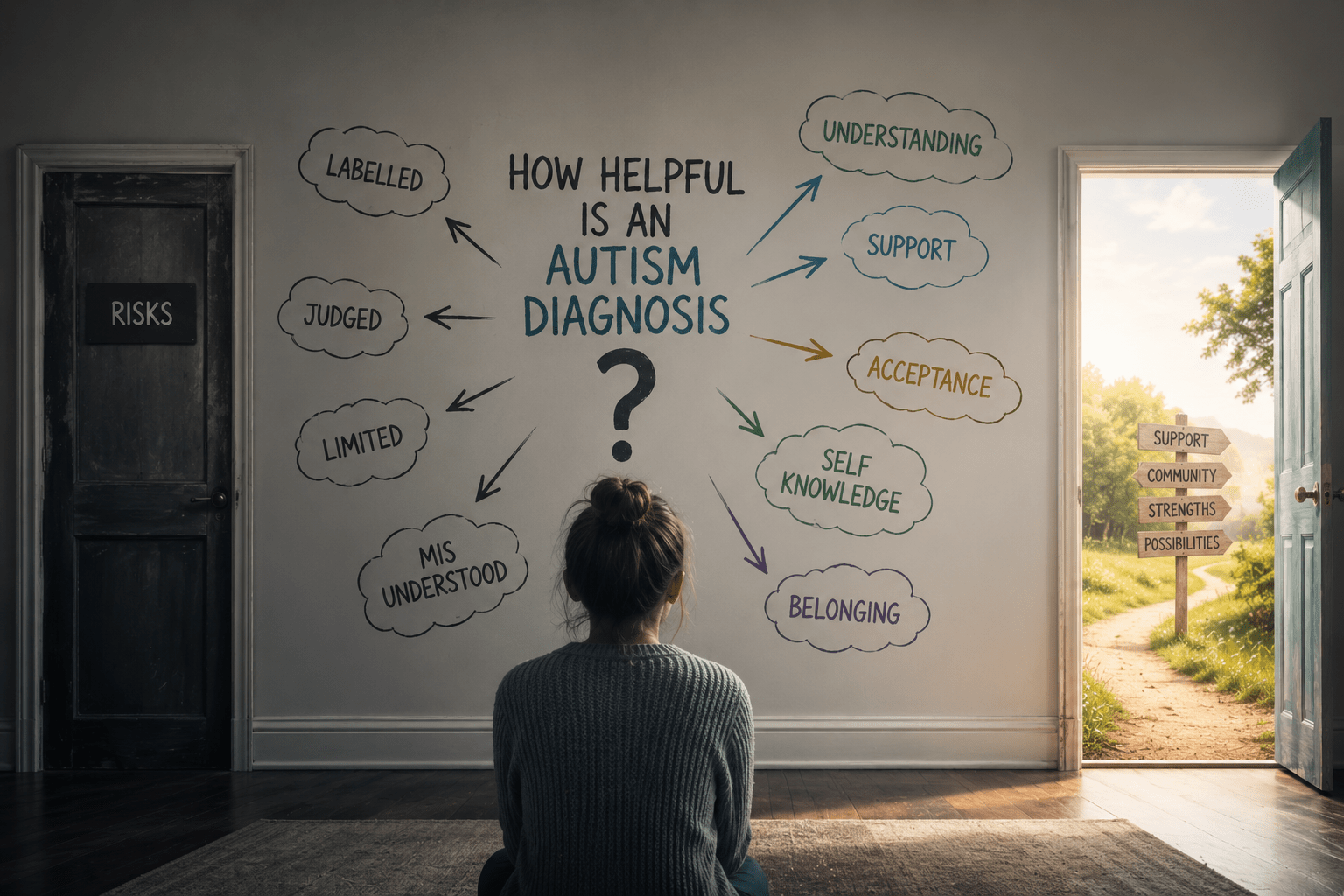
Many people come to me, feeling confused. Some come with questions about autism or ADHD, wondering if a diagnosis could be helpful. Within these questions, there’s a lot to consider and explore.
- What’s going on that has led you to consider autism or ADHD?
- What would you like from the assessment process and possible diagnosis?
- Have you thought about the drawbacks?
While I have extensive experience in the area of neurodivergence, I am not a diagnostician. We can explore your struggles, be curious and look at re-framing or different perspectives but if you feel an assessment would be helpful, I can guide this process too.
A diagnostic label can have both benefits and drawbacks. For many people, receiving a diagnosis is validating and opens the door to understanding, support, legal protections, and community. However, labels can also cause harm depending on how they are understood and used by individuals, professionals, and society.
Stereotyping, stigma and discrimination
Once someone has a diagnosis, others may begin to see the label before they see the person. This can lead to assumptions about what they can or cannot do.
Assumptions people make, may include:
- You are your diagnosis first, rather than seeing you as a person with a personality, they may think you’re:
- “Socially awkward” rather than noticing that you’re a deep thinker
- “Obsessive” rather than appreciate you’re detail orientated
- “Questioning authority” or “deliberately awkward” rather than realising you need to ask questions to understand
- “Lazy” rather the recognising the way you work and the different motivators you need
- Thinking you can’t:
- Lead a team
- Cope with change
- Communicate effectively
- Cope with challenging work
- Be organised
- Concentrate, focus or complete tasks
- You’re using your diagnosis as an excuse, dismissing your struggles thinking that “everyone’s a little bit autistic or ADHD” or you’re “jumping on the bandwagon”. Afterall, people may assume you look ok so not understand the problem!
There are many stereotypes about autism and ADHD that persist despite evidence showing they are oversimplifications or simply incorrect. While some autistic people or people with ADHD may identify with certain traits, none of these stereotypes applies universally.
Stereotypes don’t just create misunderstandings—they shape expectations and have huge implications:
- A teacher may overlook a struggling student because they don’t fit the “typical” picture
- Employers may underestimate someone’s abilities and hold them back from their full potential
- Healthcare professionals often miss diagnoses (diagnostic overshadowing)
- Social exclusion because people think you’re “weird” and won’t take time to get to know you
- Individuals often doubt their own experiences.
Ultimately, autism and ADHD are incredibly diverse. A diagnosis can tell you that someone shares certain neurodevelopmental characteristics, but it cannot tell you who they are, what they value, what they’re capable of, or what support they need. The most accurate approach is to treat each person as an individual, not as a stereotype.
Identity becoming overshadowed
A diagnosis can help a person understand as aspect of themselves but it doesn’t need to define you as a person. Sometimes people begin to be viewed only through the lens of their diagnosis.
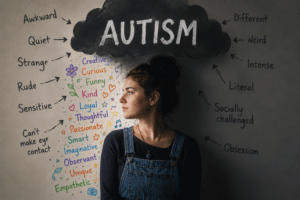
Instead of seeing all of you eg “Sam, the engineer who happens to be autistic.” You may be labelled as “Sam is autistic.” Instead of noticing your personality eg “Jane is funny and compassionate”, you may be labelled as “Jane is awkward and sensitive because she’s autistic”.
Internalised stigma
When struggling and feeling different, it can be easy to internalise external messages. When a medicalised/pathologising diagnosis is added, these messages may be reinforced:
Common thought include:
- “I’m broken.”
- “I’ll never succeed.”
- “People won’t take me seriously.”
This can affect confidence, self esteem, mental health, and willingness to pursue opportunities. For example, you may believe:
I can’t apply for any job because I’m autistic”
There may be true barriers to some job but neurodivergence, per se, doesn’t mean you can’t work, have intimate relationships or a family.
Missing individuality
Two autistic people can be vastly different.
A diagnosis tells you that someone meets certain diagnostic criteria; it doesn’t tell you:
- their strengths,
- personality,
- support needs,
- interests,
- communication style,
- coping strategies.
Over-reliance on labels can obscure this individuality.
Medicalising difference
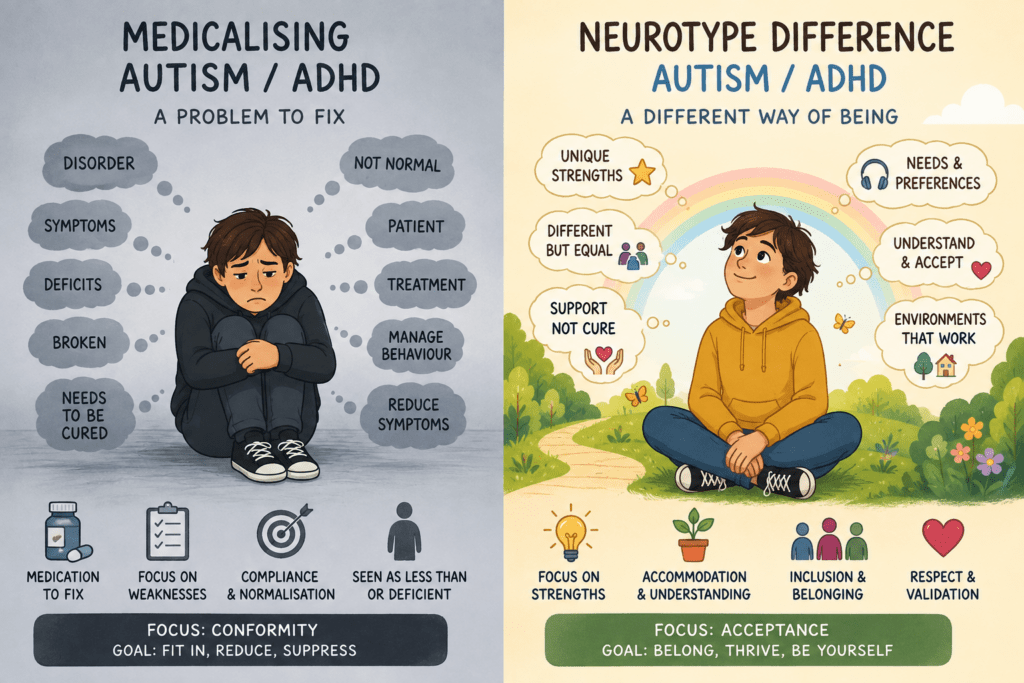
At the moment, because of the way systems and society operates, neurodivergence is medicalised with a pathologising label. This means, some see it in the same way as physical illnesses ie,
We need to fix or cure this”
Which leads to people feeling the only answer is to try and appear like everyone else. This means people won’t be interested in removing barriers or making the world more accessible but the onus is on the individual to “be better”.
But labels can also be empowering
It’s equally important not to present diagnostic labels as inherently harmful.
For many autistic people, a diagnosis:
- explains lifelong experiences,
- reduces self-blame,
- provides access to support and legal protections,
- connects them with a community,
- enables reasonable adjustments,
- helps family members and professionals understand their needs.
Many describe diagnosis as a relief rather than a burden because it replaces years of feeling “wrong” or “failing” with an explanation that makes sense.
The real issue isn’t the label
Perhaps the most balanced conclusion is this:
A diagnostic label doesn’t create stigma—society does.
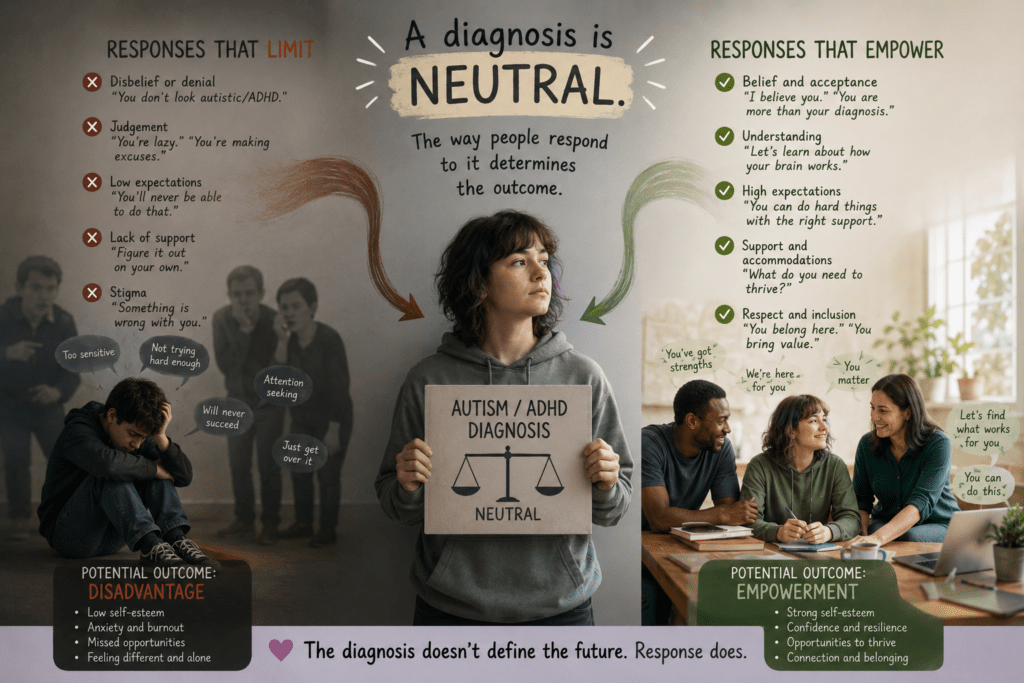
A label is simply a way of describing a recognised pattern of characteristics or experiences. It becomes harmful when it is used to stereotype, restrict opportunities, or define a person’s worth. Equally, it can be profoundly helpful when it promotes understanding, self-acceptance, appropriate support, and inclusion.
In other words, the diagnosis itself is neutral. The way people respond to it determines whether it becomes a source of empowerment or disadvantage.
If you would like to explore issues around assessment and what a diagnosis could mean for you, please contact me here.
You may wish to speak directly to someone who can guide you through the diagnostic process and other options, please find information about this with Jude Murrow or DiverseDiagnostics.