
Table of Contents
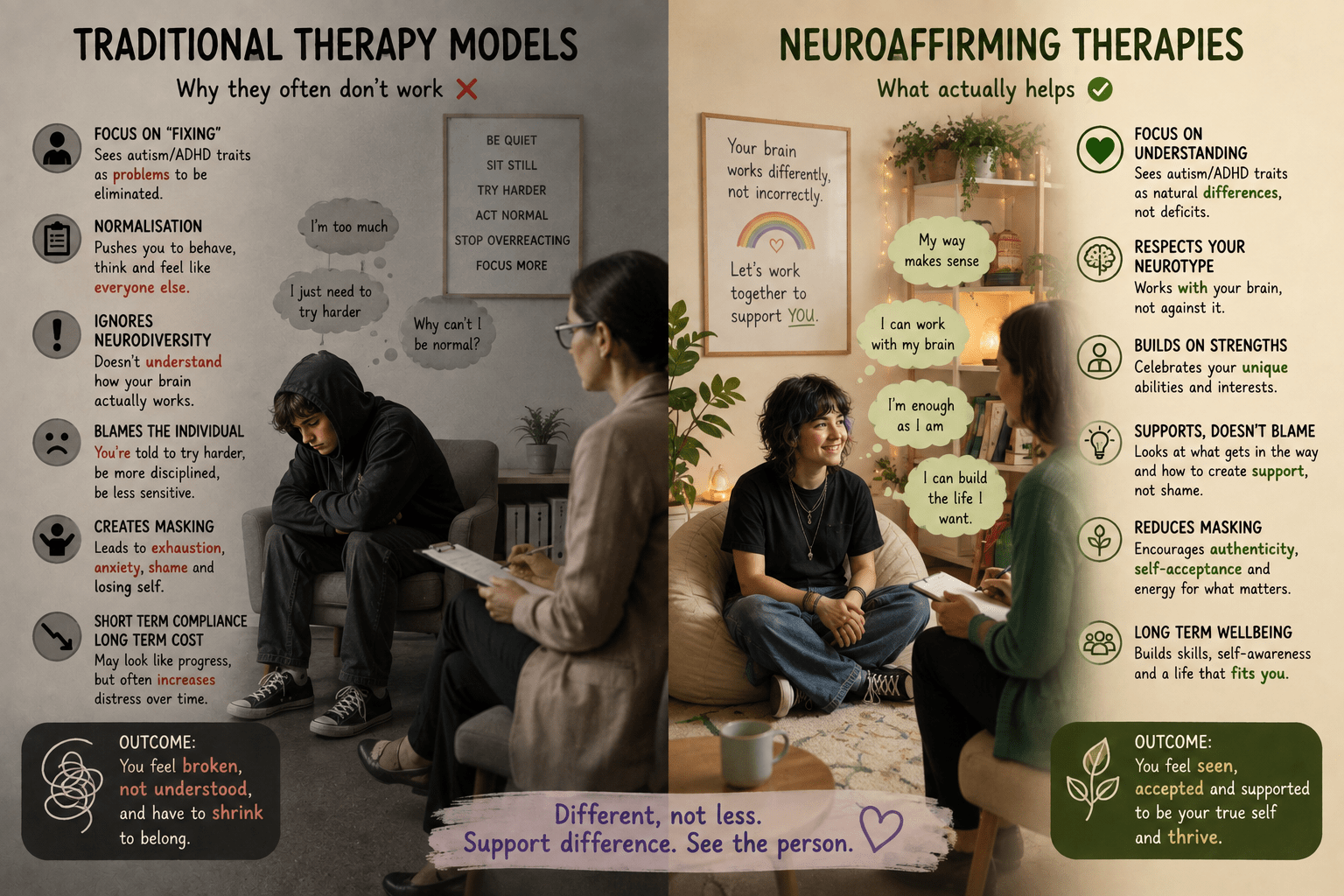
In recent years, awareness of neurodivergence—an umbrella term for neurological differences such as autism, ADHD, dyslexia, dyspraxia, and Tourette’s—has grown dramatically. Yet, while society has begun to embrace the concept of neurodiversity, mainstream mental health services have often lagged behind. Many neurodivergent people who seek counselling or psychotherapy discover that the model on offer doesn’t fully meet their needs. This isn’t because neurodivergent clients are ‘too difficult’, ‘resistant’ or doing anything wrong; rather, it’s because traditional therapy frameworks were built with the predominant neurotype (PN) assumptions at their core.
Below, we’ll explore why conventional approaches can fall short—and what the right therapist can do differently to create a truly affirming space.
Why conventional models fall short
Therapy models were designed around the predominant neurotype
Most widely used therapy models—such as cognitive behavioural therapy (CBT), psychodynamic therapy, or humanistic approaches—were developed and researched primarily with PN participants. Their assumptions about how people think, feel, and behave often mirror patterns displayed by the PN.
For instance, CBT helps individuals identify and reframe ‘irrational’ thoughts. But a neurodivergent client’s intense focus on potential risks, or their literal interpretation of social situations, may not be ‘distorted’ at all—it may be an accurate reflection of their lived experience. Applying standard CBT frameworks without adaptation can inadvertently invalidate a client’s perception which can lead to further confusion and shame.
Different communication styles
Many therapy approaches rely on verbal self-expression and abstract reflection. Sessions may involve open-ended questions, metaphors, or hypothetical scenarios. For some neurodivergent clients, especially those on the autism spectrum, these communication styles can be confusing, overwhelming, or simply inaccessible.
Clients might prefer concrete questions, direct feedback, or written communication. They may process information more slowly or need time to script their thoughts before speaking. A therapist who mistakes these differences for resistance or lack of insight risks undermining the client’s trust. A belief that the neurodivergent individual needs to ‘practice’ specific communication styles (in order to fit in) invalidates their experience and mirrors the exclusionary way society is designed.
Sensory environment

Traditional therapy spaces—soft lighting, prominent/ticking clocks, diffusers, plants/books/ornaments/pictures/other items on every surfaces—are often well thought out and designed to feel ‘cosy’ or ‘safe’, however this has a PN client in mind. For clients with sensory sensitivities, these environments can be overstimulating or even painful. A faint fragrance, humming electronics, or fluorescent lights may cause distraction or distress that makes meaningful therapy work impossible.
The neurodivergent person will be used to expending inordinate amounts of energy navigating an inaccessible world and may not even notice this is being mirrored in the therapy room. Therapists have the opportunity to show compassion and to meet the needs of the client rather than expecting them to mask.
Emotional expression isn’t universal
Therapists are trained to read body language, tone of voice, and affect as indicators of a client’s emotional state. Yet neurodivergent people may express (or mask) emotions in ways that don’t match these expectations. A client may seem flat or disengaged (when compared to the PN) but actually feel deeply connected. Another may appear highly emotional while experiencing a neutral state internally.
If a therapist interprets these cues through the PN lens, they may misjudge the client’s readiness, insight, or even safety risk. This can lead to inappropriate interventions or ruptures in the therapeutic relationship.
Pathologising difference
Perhaps the most significant challenge is that many traditional frameworks treat neurodivergence itself as a ‘problem’ to be fixed. This can show up subtly—suggesting eye contact is necessary, considering stimming is related to anxiety, or encouraging the idea that we should automatically know unwritten rules. While some clients do want help navigating social expectations, framing their differences as deficits can be harmful and perpetuate internalised shame.
Executive functioning challenges affect therapy logistics
Traditional therapy assumes that clients will remember appointments, arrive on time, complete homework, and practise skills between sessions. For ADHD or autistic clients, executive functioning differences may make these tasks much harder. Viewing these challenges through the PN lens means we might think the client is avoidant, ‘non-compliant’, lack of commitment or not being ‘ready’ for therapy. This is a profound misunderstanding.
Many therapists are taught specific boundaries are non-negotiable, eg timing of sessions. While boundaries can aid the therapeutic process, sticking to them rigidly can perpetuate shame and stigma the client already feels.
Research gaps
Because most therapy research excludes or underrepresents neurodivergent participants, there’s less evidence about what works best for these populations. Some may extrapolate that if the research exists, it is fit for all. But if interventions aren’t adapted, taking into account different communication and processing systems, harm may be caused.
It’s is important to find a practitioner who’s trained and fully informed about therapies and strategies that support a neurodivergent brain.
Neurodivergent-affirming therapy
An affirming approach recognises that neurodivergence is not an illness, but a form of human diversity. Therapy should support clients in self-acceptance, skill-building, and navigating a sometimes hostile environment—not in erasing their identity.
Therapists can support clients by offering reminders, breaking tasks into smaller steps, or practising skills in session rather than assigning them for homework.
The good news is that therapy can be transformative for neurodivergent clients when it’s adapted thoughtfully. A neurodivergence-affirming approach might include:

- Accessible environments: Offer reminders, adjust lighting, avoid scents, re-arrange seating, adjust session length or offer virtual sessions if helpful.
- Redefine success: Rather than imposing PN standards, consider the individual values and embrace difference. Break tasks down and practice during the session.
- Flexible communication: Offer written notes, visual supports, or alternative formats.
- Promote self advocacy: Neurodivergent client do not need fixing, moving towards understanding and acceptance is more nurturing than pushing for change.
- Ongoing education: Therapists should continually learn from neurodivergent voices, research, and supervision. Resources such as Weirdly Successful can be helpful.
By moving beyond one-size-fits-all models, therapists can create spaces where neurodivergent people feel understood, empowered, and respected.
Final Thoughts
Traditional therapy approaches simply weren’t designed with neurodivergent clients in mind. As awareness of neurodiversity grows, so must our therapeutic models. The future of counselling lies not in trying to make neurodivergent people fit neurotypical frameworks, but in reshaping therapy to meet the diverse ways human brains work.
When therapy honours difference rather than pathologising it, neurodivergent clients can access the full benefits of support: self-knowledge, resilience, and the confidence to navigate the world on their own terms.
If you’re interesting in neurodivergent-affirming therapy, please contact me here for a no obligation initial consultation.